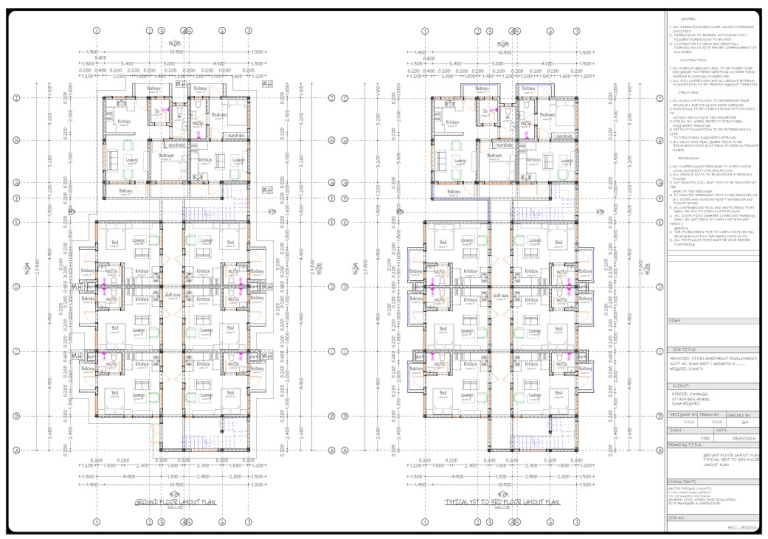
Project cost overruns remain one of the biggest reasons construction and infrastructure projects fail across Kenya — from residential builds in Nairobi’s satellite towns to commercial developments along Mombasa Road and Thika Superhighway. Whether you’re constructing a commercial building, delivering an IT implementation, or managing a residential project in Nakuru, Kisumu, or Mombasa, poor financial control can quickly erode profits and delay completion.
Learning how to reduce project cost in the Kenyan market means making informed decisions, improving planning, and eliminating unnecessary expenses while maintaining quality — all while navigating local realities like fluctuating cement and steel prices, County government approval timelines, NCA (National Construction Authority) compliance requirements, and a shilling that can shift procurement budgets overnight.
In this guide, you’ll discover practical cost-saving strategies, proven project budget management techniques, and professional tools that help Kenyan contractors, developers, and project managers stay within budget without sacrificing project outcomes.
Why Project Costs Go Over Budget in Kenya
Many projects in Kenya begin with realistic budgets but gradually exceed their financial limits. These overruns are often caused by controllable issues rather than unexpected events.
One of the most common reasons is poor planning. Without a clearly defined scope, teams frequently perform additional work that was never included in the original budget — a phenomenon known as scope creep, and one of the leading causes of cost overruns on Kenyan sites.
Another significant factor is inaccurate cost estimation. Underestimating labor, materials, equipment hire, or subcontractor costs creates substantial budget gaps as a project progresses, especially when material prices for cement, steel, and timber shift between the tendering stage and actual procurement.
Unexpected risks also contribute to rising expenses. Long rains season delays, import and clearing bottlenecks at the port of Mombasa, County approval and inspection backlogs, design revisions, and currency fluctuations affecting imported fittings and finishes can all increase project costs if contingency plans aren’t in place.
Finally, inadequate monitoring allows small financial issues to grow into major problems. Contractors and developers who fail to review actual spending against planned budgets — especially against BQ (Bill of Quantities) line items — often identify overruns too late to take corrective action.
Common Causes of Budget Overruns
| Cause | Impact |
|---|---|
| Scope Creep | Increased labor and material costs |
| Poor Planning | Delays and inefficient resource allocation |
| Inaccurate Estimates | Budget shortages |
| Material Price Inflation (cement, steel, timber) | Higher procurement costs |
| Equipment Downtime | Increased hire and maintenance expenses |
| Low Productivity | Higher labor costs |
| Weak Change Control | Unapproved project expenses |
| Poor Communication | Rework and delays |
| County Approval Delays | Idle site time and financing costs |
Understanding the root causes of cost overruns is the first step toward effective budget overrun prevention on any Kenyan project.
What Is Project Cost Management?
Project cost management is the process of planning, estimating, budgeting, financing, monitoring, and controlling project expenses throughout the project lifecycle. Its primary objective is to ensure the project is completed within the approved budget while meeting quality, scope, and schedule requirements.
Effective project cost management begins during project planning. Project managers estimate costs for labor, materials, equipment hire, permits and County approvals, and contingency reserves before creating a cost baseline against which future spending is measured.
During execution, managers continuously compare planned expenditures with actual costs — often tracked against the Bill of Quantities used in Kenyan tendering and contract administration. This ongoing process helps identify cost variances early, allowing corrective action before financial issues become critical.
Increasingly, Kenyan firms rely on digital dashboards, forecasting tools, and project cost tracking software to automate reporting and improve decision-making, giving stakeholders real-time visibility into project finances even across multiple sites.
Core Components of Project Cost Management
- Cost estimation
- Budget development
- Cost baseline creation
- Resource planning
- Procurement planning
- Cost monitoring
- Earned Value Management (EVM)
- Forecasting
- Financial reporting
- Change management
Why Cost Control Matters
Strong project spending control protects profitability and improves project success rates. Contractors and developers who monitor costs throughout execution can respond quickly to issues before they escalate — critical in a market where material prices and lead times can shift within weeks.
Cost control also strengthens stakeholder confidence. Clients, investors, and financiers are more likely to trust firms that consistently deliver projects on time and within budget, which matters for repeat business and referrals in Kenya’s relationship-driven construction sector.
Disciplined financial management also supports better decision-making. Project managers can evaluate whether proposed scope changes, procurement options, or scheduling adjustments provide sufficient value before committing additional funds.
Ultimately, effective cost optimization ensures every shilling contributes to project objectives, helping firms achieve higher returns while maintaining the quality standards Kenyan clients expect.
Key Benefits of Effective Cost Control
- Prevents budget overruns
- Improves cash flow management
- Enhances resource allocation efficiency
- Reduces unnecessary spending
- Supports better procurement decisions
- Increases project profitability
- Improves client satisfaction
- Strengthens long-term organizational performance
15 Proven Ways to Reduce Project Cost in Kenya
1. Define the Project Scope Clearly
One of the fastest ways to reduce project cost is to establish a detailed project scope before work begins. A well-defined scope outlines project objectives, deliverables, timelines, responsibilities, and acceptance criteria. When everyone understands what is included, unnecessary work is less likely to occur.
Scope creep happens when additional work is introduced without adjusting the budget or schedule. Although individual changes may seem minor, they often accumulate into significant cost overruns — a common issue on residential builds in Kenya where clients request finishes changes mid-construction. Establishing a formal change approval process ensures every proposed change is evaluated for its financial and scheduling impact.
A Work Breakdown Structure (WBS) also improves scope clarity by dividing the project into manageable tasks, simplifying budgeting, scheduling, and resource allocation while minimizing overlooked activities.
Best Practices for Scope Control
- Develop a detailed scope statement
- Define project deliverables
- Create a Work Breakdown Structure (WBS)
- Obtain stakeholder approval before execution
- Review every scope change before approval
- Maintain a change control log
Projects with clearly documented scopes experience fewer disputes, less rework, and more predictable budgets.
2. Create a Detailed Project Budget
A realistic budget serves as the financial roadmap for every project. Rather than relying on rough estimates, successful project managers break costs into categories such as labor, materials, equipment, subcontractors, permits and approvals, overhead, and contingency reserves.
Detailed budgeting also improves cash flow planning. Knowing when expenses will occur helps avoid funding shortages that can delay work or force expensive short-term borrowing — a common pressure point for Kenyan contractors managing multiple draw-downs against a client’s payment schedule.
Budgets should remain flexible enough to accommodate unforeseen risks (like a sudden jump in cement prices) while maintaining strict control over discretionary spending. Regular budget reviews ensure assumptions remain valid as project conditions evolve.
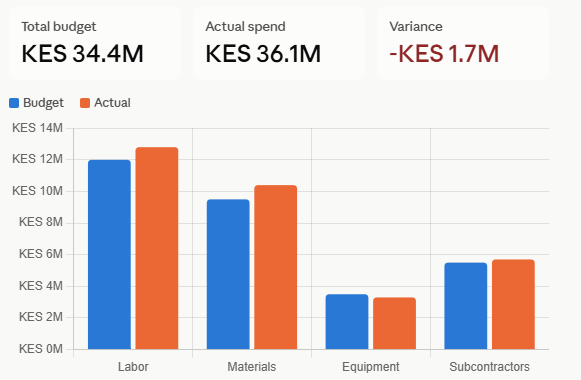
Sample Project Budget (KES)
| Cost Category | Estimated Cost |
|---|---|
| Labor | KES 12,000,000 |
| Materials | KES 9,500,000 |
| Equipment | KES 3,500,000 |
| Subcontractors | KES 5,500,000 |
| Permits & County Approvals | KES 800,000 |
| Contingency (10%) | KES 3,130,000 |
| Total Budget | KES 34,430,000 |
Budgeting Tips
- Base estimates on current local market prices, not last quarter’s
- Include a realistic contingency (10–15% is common for Kenyan sites given price volatility)
- Separate direct and indirect costs
- Review budgets monthly
- Update forecasts as conditions change
A detailed budget is one of the strongest defenses against unexpected project expenses.
3. Improve Cost Estimation
Poor estimates often cause projects to exceed their budgets long before construction is complete. Accurate cost estimation requires reliable historical data, current supplier pricing, labor productivity rates, and realistic risk assumptions — particularly important in Kenya, where cement, steel, and fuel prices can move significantly within a single project timeline.
Using outdated cost information creates an unrealistic budget that cannot absorb inflation or market changes. Project managers should verify prices immediately before finalizing estimates and update them whenever significant changes occur.
Combining multiple estimating methods improves accuracy. Bottom-up estimating calculates the cost of individual tasks before aggregating them into a project total, while analogous and parametric estimating provide useful benchmarks from comparable past projects.
Estimation Methods
| Method | Best Use |
|---|---|
| Analogous Estimating | Early planning |
| Parametric Estimating | Repetitive projects |
| Bottom-Up Estimating | High accuracy |
| Three-Point Estimating | High-risk projects |
Common Estimation Mistakes
- Ignoring inflation and currency exposure
- Forgetting indirect costs
- Underestimating labor hours
- Excluding contingency reserves
- Using outdated supplier prices
4. Use Value Engineering
Value engineering is a structured process that improves project value by identifying lower-cost alternatives without reducing quality, safety, or functionality. Instead of simply cutting expenses, it focuses on delivering the same or better outcomes more efficiently.
For example, substituting an equally durable local material for an imported one, redesigning structural elements for efficiency, or selecting prefabricated components can significantly reduce labor and material costs on Kenyan projects.
Successful value engineering involves collaboration among architects, structural engineers, contractors, and procurement teams. Their combined expertise helps uncover practical solutions — such as sourcing quarried stone or locally manufactured steel instead of imported alternatives — that maintain performance while lowering expenses.
Value Engineering Examples
| Original Solution | Optimized Alternative | Potential Savings |
|---|---|---|
| Cast-in-place concrete | Precast panels | 12–20% |
| Custom imported windows | Standard local sizes | 8–15% |
| Imported finishes | Local suppliers | 10–18% |
| Manual reporting | Digital dashboards | 20–40% admin savings |
5. Control Scope Changes
Not every requested change should be approved. Even beneficial modifications can increase costs, delay schedules, and affect resource availability.
A formal change control process ensures each request is documented, reviewed, and approved only after evaluating its impact on budget, timeline, quality, and risk. This discipline prevents unauthorized work and protects a project’s financial health.
Clients should understand that changes are not “free” — even a simple finishes upgrade can ripple through procurement lead times and labor sequencing. Transparent communication about cost implications encourages better decision-making and reduces unnecessary requests.
Change Control Checklist
- Document the requested change
- Estimate additional costs
- Assess schedule impact
- Evaluate project risks
- Obtain written approval
- Update the budget and schedule
6. Negotiate with Vendors and Suppliers
Procurement often represents a significant portion of total project costs. Strong vendor relationships and effective negotiation strategies can reduce expenses without compromising quality — especially valuable in a market where hardware suppliers, quarries, and steel fabricators compete actively for contractor business.
Competitive bidding encourages suppliers to offer better pricing, while long-term partnerships may provide discounts, favorable payment terms, or priority delivery during high-demand periods. Bulk purchasing can also lower unit costs when managed carefully.
Negotiations should consider more than price. Warranty terms, delivery reliability, payment flexibility, and after-sales support all influence the total cost of ownership.
Supplier Negotiation Strategies
- Request multiple quotations
- Bundle purchases for volume discounts
- Negotiate longer payment terms
- Compare lifecycle costs, not just purchase price
- Build long-term supplier partnerships
- Prioritize reliable local sourcing to reduce transport and lead-time risk
| Negotiation Strategy | Benefit |
|---|---|
| Competitive bidding | Lower prices |
| Volume purchasing | Bulk discounts |
| Long-term contracts | Stable pricing |
| Early payment discounts | Reduced overall cost |
| Local sourcing | Lower transportation expenses |
7. Reduce Material Waste
Material waste directly increases project costs by requiring additional purchases and increasing disposal expenses. Effective inventory management and careful planning minimize these losses.
Ordering the correct quantities reduces excess inventory while protecting against shortages that delay work. Proper on-site storage prevents damage caused by weather (a real concern during the long and short rains), theft, or poor handling.
Site teams should measure waste rates regularly and identify recurring issues. Small improvements in cutting accuracy, handling procedures, or storage practices can produce substantial savings across large projects.
Waste Reduction Strategies
- Improve inventory management
- Store materials correctly and securely
- Order accurate quantities
- Recycle usable materials
- Train workers on proper handling
- Monitor waste percentages
Every percentage point of material waste eliminated contributes directly to lower project costs and improved profitability.
8. Increase Labor Productivity
Labor is frequently the largest project expense. Improving productivity allows teams to complete more work within the same timeframe, reducing overall labor costs without reducing workforce quality.
Clear work plans, effective supervision, and regular communication help eliminate downtime and confusion. Investing in worker training also improves efficiency by reducing mistakes and rework.
Technology can further enhance productivity. Mobile reporting tools, digital drawings, scheduling software, and automated inspections reduce administrative tasks, allowing skilled workers to focus on value-added activities.
Ways to Improve Productivity
- Develop realistic work schedules
- Provide ongoing skills training
- Eliminate unnecessary waiting time
- Improve communication among teams
- Use digital collaboration tools
- Recognize and reward high performance
| Productivity Issue | Cost Impact | Recommended Solution |
|---|---|---|
| Rework | High | Improve quality control |
| Idle labor | High | Better scheduling |
| Poor communication | Medium | Daily coordination meetings |
| Skill gaps | Medium | Training programs |
| Equipment delays | High | Preventive maintenance |
9. Optimize Equipment Utilization
Equipment represents one of the largest expenses in construction and infrastructure projects. Idle machines, poor maintenance, and inefficient scheduling increase operating costs without adding value.
Instead of purchasing equipment that will only be used occasionally, evaluate whether renting from a local plant hire company is more cost-effective. Sharing equipment across multiple sites can also improve utilization rates and reduce ownership costs.
Preventive maintenance is equally important. Regular servicing minimizes breakdowns, extends equipment life, and reduces expensive emergency repairs that can halt project progress.
Strategies to Improve Equipment Efficiency
- Schedule equipment according to project needs
- Perform preventive maintenance regularly
- Monitor fuel consumption
- Eliminate unnecessary idle time
- Share equipment across projects
- Replace outdated, inefficient machinery
| Equipment Issue | Cost Impact | Recommended Action |
|---|---|---|
| Idle excavator | High | Reassign or return rental |
| Poor maintenance | High | Preventive maintenance schedule |
| Excessive fuel use | Medium | Monitor fuel efficiency |
| Duplicate equipment | Medium | Share resources between sites |
| Frequent breakdowns | High | Replace aging equipment |
10. Track Project Costs Regularly
Many projects fail because financial problems are identified too late. Regular cost tracking enables project managers to compare planned spending with actual expenditures and take corrective action before small issues become major overruns.
Weekly or bi-weekly cost reviews help teams identify trends, monitor resource usage, and update financial forecasts. Modern project management software provides real-time dashboards that simplify this process, even for firms managing several sites across different counties.
Cost tracking should include labor, materials, equipment, subcontractors, overhead, and contingency spending. Reviewing all cost categories together provides a complete picture of project financial health.
Benefits of Regular Cost Monitoring
- Detect budget overruns early
- Improve financial forecasting
- Support faster decision-making
- Increase accountability
- Reduce unnecessary spending
- Improve stakeholder reporting
Earned Value Management (EVM): A Powerful Cost Control Technique
Earned Value Management (EVM) is one of the most effective methods for measuring project performance. It compares planned work, completed work, and actual spending to determine whether a project is on budget and on schedule.
Unlike basic budget tracking, EVM reveals performance trends early, allowing project managers to make informed decisions before problems escalate.
Key EVM Terms
| Metric | Formula | Purpose |
|---|---|---|
| Planned Value (PV) | Budgeted cost of scheduled work | Measures planned progress |
| Earned Value (EV) | Budgeted cost of completed work | Measures actual progress |
| Actual Cost (AC) | Actual amount spent | Measures expenditure |
| Cost Variance (CV) | EV − AC | Budget performance |
| Schedule Variance (SV) | EV − PV | Schedule performance |
| Cost Performance Index (CPI) | EV ÷ AC | Cost efficiency |
| Schedule Performance Index (SPI) | EV ÷ PV | Schedule efficiency |
Cost Variance Formula: Cost Variance (CV) = Earned Value (EV) − Actual Cost (AC)
| Result | Meaning |
|---|---|
| Positive CV | Under budget |
| Zero CV | On budget |
| Negative CV | Over budget |
Example
Assume a project has:
- Planned Value (PV): KES 15,000,000
- Earned Value (EV): KES 14,000,000
- Actual Cost (AC): KES 15,500,000
Calculations:
- CV = 14,000,000 − 15,500,000 = −KES 1,500,000
- CPI = 14,000,000 ÷ 15,500,000 = 0.90
This indicates the project is over budget and is only earning KES 0.90 of value for every KES 1.00 spent. Management should investigate the causes and implement corrective actions promptly.
11. Identify and Eliminate Hidden Project Costs
Hidden costs often go unnoticed during planning but can significantly affect the final project budget. These expenses accumulate gradually and are frequently overlooked until late in the project.
Common examples in the Kenyan context include overtime pay, equipment downtime, County approval and inspection delays, quality rework, transportation costs from quarries or suppliers outside the city, insurance adjustments, and administrative overhead. Although each expense may appear minor, their combined impact can be substantial.
Regular financial reviews help identify these hidden costs early. Maintaining detailed records also allows firms to improve future estimates and budgeting accuracy.
Common Hidden Project Costs
| Hidden Cost | How to Reduce It |
|---|---|
| Rework | Strengthen quality assurance |
| Equipment downtime | Preventive maintenance |
| Overtime | Improve scheduling |
| Material theft | Better site security |
| Design revisions | Thorough planning and review |
| Delivery delays | Reliable suppliers |
| Administrative inefficiencies | Digital workflows |
| Safety incidents | Comprehensive safety training |
| County approval delays | Submit applications early, engage a liaison |
Hidden costs rarely appear as one large expense. Instead, they accumulate through small, repeated inefficiencies.
12. Manage Risks Before They Become Expenses
Every project faces uncertainty, but effective risk management reduces the financial impact of unexpected events. Instead of reacting to problems after they occur, proactive teams identify potential risks and develop mitigation strategies.
A Risk Register documents each identified risk, its likelihood, potential impact, mitigation measures, and responsible owner. Regular reviews keep this document relevant as project conditions evolve — particularly for Kenyan projects exposed to seasonal weather, currency movement on imported materials, and regulatory timelines.
Including contingency reserves in the budget also improves resilience. While no project can eliminate every risk, preparation significantly reduces costly disruptions.
Sample Risk Register
| Risk | Probability | Impact | Mitigation |
|---|---|---|---|
| Material price increase | High | High | Secure supplier contracts early |
| Long rains / severe weather | Medium | High | Adjust project schedule |
| Labor shortages | Medium | Medium | Cross-train workforce |
| Equipment failure | Medium | High | Preventive maintenance |
| County approval delays | Medium | High | Submit applications early |
13. Improve Resource Allocation Efficiency
Efficient resource allocation ensures that labor, equipment, and materials are available when needed without creating unnecessary costs.
Overstaffing increases labor expenses, while understaffing causes delays and overtime. Similarly, ordering materials too early increases storage and security costs, whereas late deliveries disrupt project schedules.
Project scheduling software and resource planning tools help managers optimize utilization and reduce idle time — especially useful for firms coordinating work across multiple sites in Nairobi and beyond.
Best Practices
- Balance workloads across teams
- Schedule resources based on project priorities
- Avoid unnecessary overtime
- Monitor resource utilization weekly
- Update schedules when conditions change
Best Cost Control Tools for Project Management
Technology plays a crucial role in modern project cost management. The right software improves visibility, automates reporting, and supports informed decision-making — many of these tools are now widely used by Kenyan contractors and consultants alongside traditional BQ-based tracking.
| Tool | Primary Use | Best For |
|---|---|---|
| Microsoft Project | Scheduling and budgeting | Large projects |
| Primavera P6 | Enterprise project controls | Infrastructure |
| Procore | Construction management | Contractors |
| Autodesk Construction Cloud | Project collaboration | Construction teams |
| Oracle Aconex | Document control | Mega projects |
| Microsoft Excel | Budget tracking | Small to medium projects |
| Power BI | Cost dashboards | Executive reporting |
| Jira | Agile project tracking | IT and software projects |
Real-World Case Study: Reducing Costs on a Commercial Building Project
A contractor was awarded a KES 1.2 billion office building project in Nairobi with a 16-month schedule. During the first quarter, management identified rising labor costs and excessive material waste that threatened profitability.
The project team responded by redefining work packages, introducing stricter inventory controls, renegotiating supplier contracts, and implementing weekly Earned Value Management reviews. They also increased worker training and improved equipment scheduling.
As a result, material waste decreased by 14%, equipment idle time fell by 22%, and labor productivity improved by 11%. The project was completed 3% under budget, demonstrating how disciplined cost management can deliver measurable financial benefits even on large, complex Kenyan developments.
Lessons Learned
- Early monitoring prevents major overruns
- Data-driven decisions improve resource allocation
- Supplier relationships influence overall project costs
- Small operational improvements create significant cumulative savings
Quick Cost Reduction Checklist
- ✔ Clearly define the project scope
- ✔ Develop a realistic budget
- ✔ Improve cost estimation accuracy
- ✔ Apply value engineering principles
- ✔ Control scope changes
- ✔ Negotiate supplier contracts
- ✔ Reduce material waste
- ✔ Improve labor productivity
- ✔ Optimize equipment utilization
- ✔ Track project costs weekly
- ✔ Use Earned Value Management
- ✔ Maintain a risk register
- ✔ Review hidden costs regularly
- ✔ Use project management software
- ✔ Conduct lessons learned reviews after project completion
Build a Complete Project Cost Management Plan
A Project Cost Management Plan outlines how costs will be estimated, approved, monitored, controlled, and reported throughout the project lifecycle. Rather than reacting to budget issues, it establishes a structured process for maintaining financial discipline from initiation to closeout.
An effective plan defines cost responsibilities, reporting frequency, performance metrics, approval procedures, and corrective actions. Every stakeholder — client, architect, structural engineer, and contractor — should understand how project costs will be managed before work begins.
The plan should also align with the project’s schedule, procurement strategy, and risk management framework. Integrating these processes creates a consistent approach to financial decision-making.
Essential Components of a Cost Management Plan
| Component | Purpose |
|---|---|
| Cost Estimation | Forecast project expenses |
| Budget Baseline | Approved financial benchmark |
| Cost Tracking | Monitor actual spending |
| Change Control | Manage scope-related costs |
| Procurement Plan | Control purchasing expenses |
| Risk Register | Identify financial risks |
| Cash Flow Forecast | Predict funding requirements |
| Performance Reports | Communicate project status |
| Earned Value Management | Measure cost efficiency |
| Lessons Learned | Improve future projects |
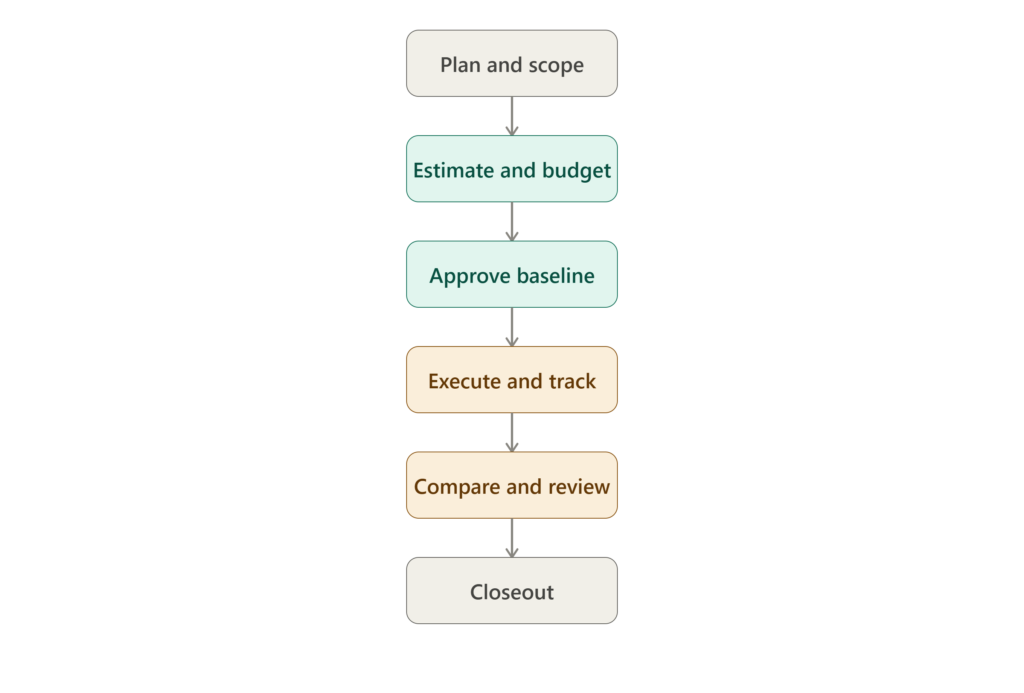
Project Cost Control Workflow
This workflow applies to projects of any size, from residential construction in Nairobi’s suburbs to large infrastructure developments countrywide:
Project Planning
      │
      ▼
Define Scope
      │
      ▼
Estimate Costs
      │
      ▼
Develop Budget
      │
      ▼
Approve Budget Baseline
      │
      ▼
Execute Project
      │
      ▼
Track Actual Costs
      │
      ▼
Compare Budget vs. Actual
      │
      ▼
Identify Variances
      │
      ▼
Take Corrective Action
      │
      ▼
Project Closeout & Lessons Learned
Related Article: Step-by-Step House Construction in Kenya (2026 Complete Guide from Land Purchase to Handover)
Following a structured workflow improves accountability, simplifies reporting, and helps prevent budget overruns before they become critical.
Expert Best Practices for Long-Term Cost Control
Reducing project cost is not a one-time activity. Successful firms embed cost management into every stage of project delivery.
Some of the most effective long-term practices include:
- Review project budgets weekly instead of monthly
- Use historical project data to improve future estimates
- Digitize financial reporting to reduce manual errors
- Encourage collaboration between architecture, engineering, procurement, and finance teams
- Conduct post-project reviews to identify recurring inefficiencies
- Monitor productivity metrics alongside financial performance
- Invest in employee training to reduce costly mistakes
- Build strong relationships with reliable local suppliers
“The cheapest project is rarely the most successful. The best projects deliver maximum value while controlling costs through disciplined planning and execution.”
Common Mistakes That Increase Project Costs
Avoiding common mistakes is often easier than correcting them after they occur.
| Mistake | Consequence |
|---|---|
| Poor planning | Budget overruns |
| Weak scope definition | Scope creep |
| Ignoring project risks | Unexpected expenses |
| Delayed decision-making | Schedule delays |
| Poor communication | Rework |
| Unrealistic schedules | Overtime costs |
| Lack of cost tracking | Financial surprises |
| Choosing suppliers based only on price | Lower quality and expensive rework |
| Inadequate quality control | Defects and corrections |
| Failing to review lessons learned | Repeating the same mistakes |
Interactive project cost readiness checklist that scores planning, budget, execution, and monitoring preparedness and offers a contact option
Overall
0%
Planning
0/4
Budget
0/3
Execution
0/4
Monitoring
0/4
Planning
Budget
Execution
Monitoring
Tick off items above to see your project readiness insight.
Frequently Asked Questions
Final Thoughts
Every successful project begins with a realistic budget and ends with disciplined financial management. While unexpected challenges are inevitable in any market, they don't have to result in costly overruns. Firms that invest time in planning, estimating, monitoring, and continuous improvement consistently deliver better financial outcomes — even amid Kenya's shifting material prices and regulatory timelines.
The most effective way to reduce project cost is not by cutting corners but by eliminating waste, improving productivity, controlling scope, and making informed decisions throughout the project lifecycle. Whether you're managing a residential build in a Nairobi suburb, a commercial development, an infrastructure project, or an IT implementation, these proven strategies will help you maximize value while protecting your budget.
Cost control is a continuous process, not a single activity. Regular performance reviews, strong communication, accurate reporting, and lessons learned from previous projects create a culture of financial discipline that benefits every future project.